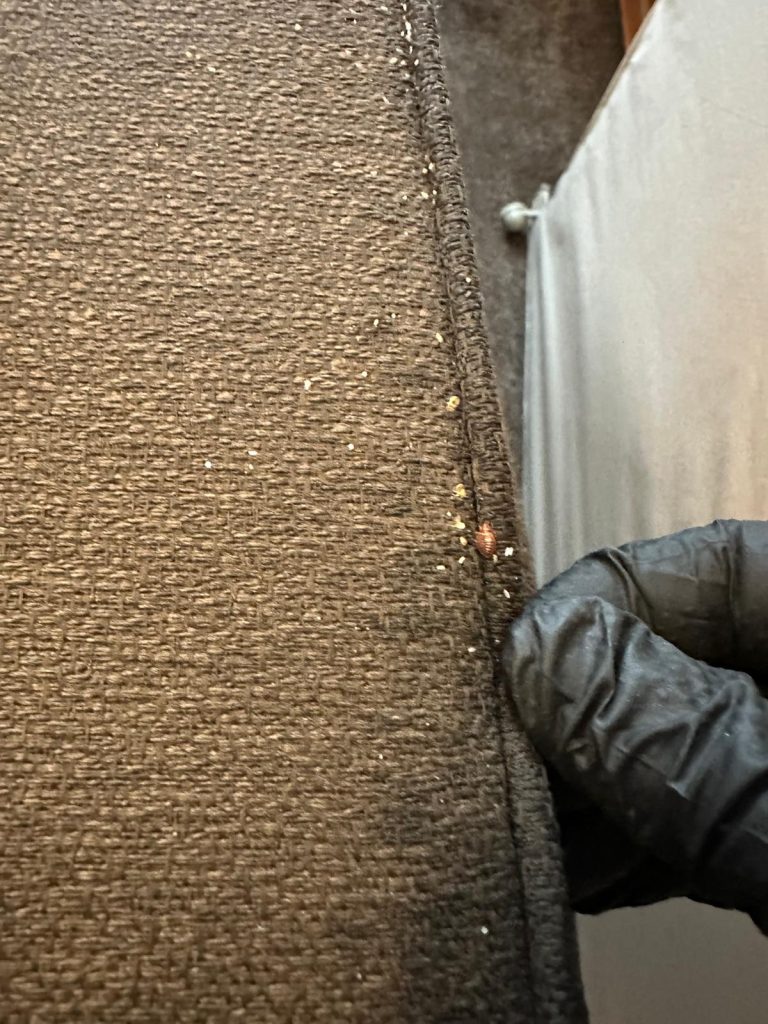
Pest Shield was instructed to investigate reports of suspected bed bug activity at a residential property in Newcastle NE4.
The property was occupied by a non-verbal autistic adult whose care team had become concerned after noticing unexplained bite marks. As the resident was unable to communicate that they were being bitten, it was difficult to determine how long the issue had been present or whether bed bugs were responsible.
A detailed inspection was requested to establish whether an active infestation was present and to identify any likely source of introduction.
A thorough inspection of the bedroom confirmed an active bed bug infestation.
Live adult bed bugs, nymphal stages and numerous eggs were discovered within the gap between the two sections of the divan bed base. This concealed void provided ideal harbourage, allowing the insects to remain hidden during the day while remaining close to the sleeping occupant.
The presence of adults, juvenile stages and eggs confirmed that the infestation was well established rather than the result of a recent introduction.
Following confirmation of the infestation, a structured treatment programme was commenced.
All accessible areas of the bedroom, excluding the mattress, were treated with a residual application of 50 ml of Cimetrol in accordance with the product label.
The mattress was treated separately using 25 ml of Biopren, providing an appropriate residual treatment while remaining suitable for use on the sleeping surface.
Particular attention was given to:
The customer’s care team was advised to keep the treated room vacant for four hours following treatment.
A follow-up visit was scheduled three weeks later in accordance with standard bed bug treatment protocols.
During discussions with the care team, it became apparent that the resident regularly attended respite accommodation.
As bed bugs are frequently transported on clothing, bedding and personal belongings, this was identified as a potential source of repeated exposure.
Contact tracing was undertaken and the respite facility was notified. Further investigation confirmed bed bug activity at the second location, allowing treatment to be arranged there as well.
By identifying and addressing the likely source of the infestation, the risk of repeated introductions following treatment was significantly reduced.
The inspection not only confirmed an active bed bug infestation but also identified the most likely route by which the insects had entered the property.
Treating both the affected bedroom and the suspected source of reintroduction provided the best opportunity for long-term control and reduced the likelihood of the infestation recurring.
This case highlights the importance of looking beyond the immediate infestation and considering how pests may have been introduced in the first place.
Bed bug infestations are not always straightforward, particularly where vulnerable occupants are unable to recognise or communicate the problem.
In this case, the inspection confirmed an established infestation while further investigation identified a likely external source. Without tracing that source, treatment of the property alone may not have prevented future infestations.
This investigation demonstrates the value of a thorough inspection, careful questioning and evidence-led pest management.
Property Type: Residential Property
Location: Newcastle upon Tyne NE4
Services Provided: Bed Bug Inspection, Residual Insecticide Treatment, Insect Growth Regulator Application, Contact Tracing, Follow-up Monitoring