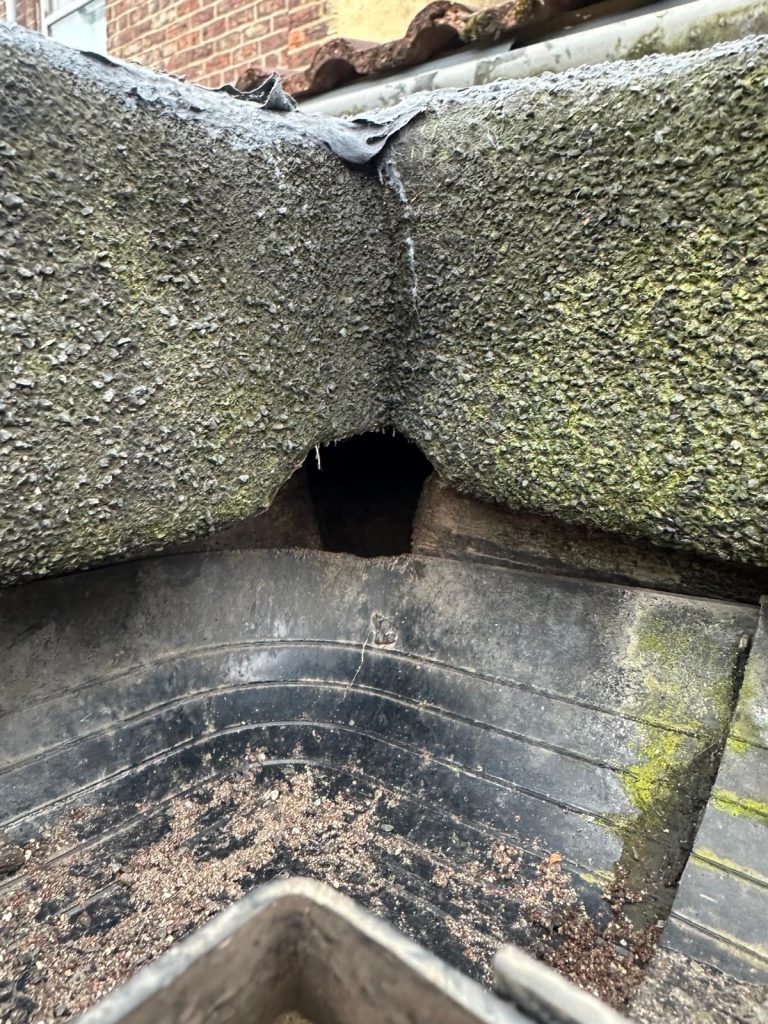
One of the most common and most frequently missed causes of rat infestations is damaged drainage.
Rats naturally live in sewer systems. If a drain is cracked, poorly connected, or has been altered, they can escape and move into the structure of a building. From there, they enter through floor voids, basements, or service penetrations.
We regularly find issues where pipes have been installed using underground moling. This can break or displace existing drains without it being obvious above ground. Once compromised, the drainage system becomes a direct access route into the property.
Pipes entering the property are a common weak point.
Gas, water, and waste pipes often pass through walls or floors with gaps left around them. These gaps are frequently hidden behind kitchen units, boxing, or in cupboards.
If the pipe runs from an external wall or connects to a compromised drain, rats will use this route to enter.
Air bricks are designed to ventilate the subfloor, but if they are damaged, poorly fitted, or not meshed correctly, they become an easy entry point.
Once inside the subfloor, rats can travel freely beneath the property and access internal areas through gaps in flooring, pipework, or wall voids.
Rats exploit weaknesses in the structure of a building.
This includes gaps under doors, broken brickwork, poorly sealed extensions, cavity wall defects, and damaged soffits or fascia boards.
Even small construction defects can provide enough access for a rat to enter and establish inside.
Rats are strong climbers and will access roofs via fences, drainpipes, and nearby structures.
They can enter through gaps in roofing, broken tiles, or unsealed eaves. Once inside the loft, they can move down into wall cavities and living spaces.
In semi-detached and terraced properties, buildings are not fully separated. They often share cavity walls, subfloor voids, loft spaces, and service runs, which allows rats to move freely between properties without ever going outside.
This means you can resolve activity within one property, but if rats are established next door, they can simply move back through these shared voids and re-enter.
Where neighbouring properties have ongoing infestations or are not engaging with treatment, this creates constant pressure. In these situations, control can be difficult and in some cases impossible to fully resolve until the wider issue is addressed.
Effective long-term control may require cooperation between properties to remove both the infestation and the access routes.
Most rat problems are treated without identifying the root cause.
If only baiting or trapping is used, the immediate population may be reduced, but the access point remains. This leads to recurring issues, often mistaken for new infestations.
Drainage defects in particular are commonly overlooked because they are not visible without proper inspection.
We regularly attend properties where rats are entering through issues that have previously been missed.
A common example involves utility works, where gas or water mains have been installed using a method called moling. This is where a machine drives a pipe horizontally through the ground without digging a trench, often used to install services quickly with minimal disruption.
The issue arises when this process cuts through or damages an existing drain line. In many cases, this goes unnoticed because everything looks fine at surface level. However, underground, it can leave a broken or open connection between the drainage system and the surrounding ground.
This creates a direct escape route for rats from the sewer system into the subfloor or foundations of the property.
Without identifying and resolving this type of fault, treatments alone will only ever provide short-term results, as rats will continue to re-enter through the same route.
Effective rat control is not just about removing the rats currently present. It requires removing their ability to return.
This typically involves:
Identifying the exact entry point through a full inspection
Repairing structural defects such as gaps and damaged vents
Addressing drainage issues, including repairs or installing non-return valves
Reducing harbourage and access around the exterior
Once access is removed, ongoing infestations stop.
If you are experiencing repeated rat activity, hearing movement within the structure, or have had previous treatments that have not worked, a full inspection is required.
An inspection-led approach identifies not just where rats are, but how and why they are entering. This is the difference between short-term control and a permanent solution.
How rats get into your house is closely linked to other common issues: